

Harmony in a Fractured World
There’s a story I keep coming back to whenever I think about how music can heal. During the First World War, just a short distance from where I live in West-Flanders, soldiers in the trenches experienced a rare moment of humanity. On Christmas Eve 1914, amidst the horrors of war, they put down their weapons. In the cold and mud of the battlefield, carols rose from the trenches. One side began singing, and soon the other joined in. For a few precious hours, music became a bridge over the deep divide of war.
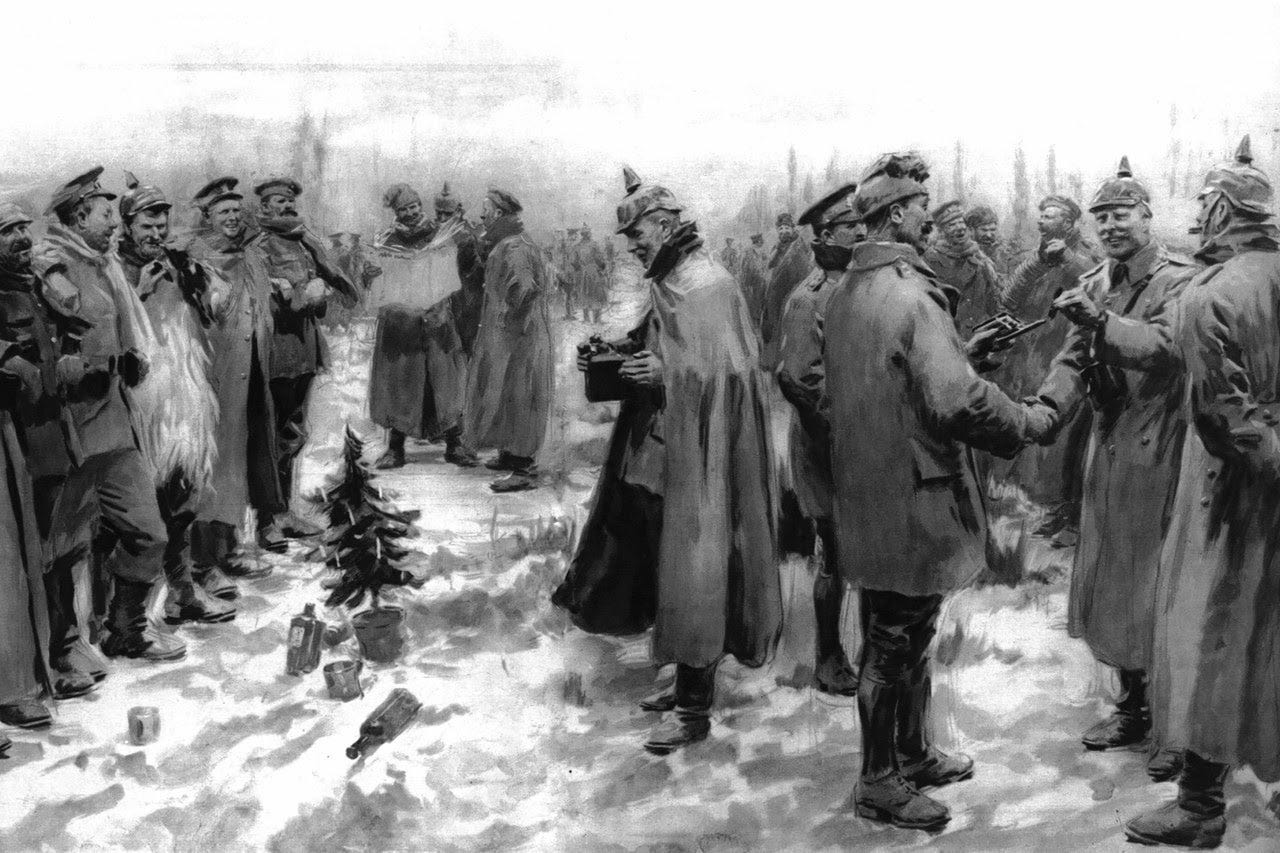
From The Illustrated London News of January 9, 1915: "British and German Soldiers Arm-in-Arm Exchanging Headgear: A Christmas Truce between Opposing Trenches"
Living so close to these battlefields, I often feel the weight of that history. The names of towns like Ypres (Ieper) and Passchendaele (Passendale)1 are etched into the collective memory as symbols of suffering and sacrifice. The idea that music—something so simple and universal—could bring even a brief sense of peace to such a dark place is deeply moving to me.
Today, sadly, the image of trenches isn’t just history. In Ukraine, soldiers and civilians alike are experiencing the horrors of war. Many have taken shelter underground in metro stations to escape bombings, turning these spaces into temporary havens. What strikes me most is that even in these dire circumstances, music continues to exist. Ukrainian musicians have been playing violins or singing in subway stations2, creating moments of beauty and connection amid the chaos.
This phenomenon inspired one of the tracks on my first EP, Rubble. The song, Submerged, is my attempt to capture both the despair and the resilience of those moments. The track begins with the sound of a cellist playing in a metro station. You can hear the sirens and bomb impacts in the background, and then the music shifts as the piano and bass come in. The cello introduces the main theme, which the trumpet later takes over with an improvisation. Gradually, the cello and violin join to support the trumpet. The song builds to a powerful crescendo with all the instruments repeating the theme, and finally resolves on a major chord. For me, that chord is a symbol of hope—a reminder that even in the darkest times, there’s light to be found.
Music as Connection
The thing about music is that it doesn’t need translation. A melody doesn’t ask you where you’re from, what you believe, or who you vote for. It just exists, and it moves you (or not).
I remember a concert by Ibrahim Maalouf in Antwerp a few years ago3 where the audience experienced this power. The venue, De Roma in Borgerhout, couldn’t be more symbolic. De Roma sits on the Turnhoutsebaan, the lifeline of Borgerhout and a crossroads where all the challenges of urban life come together. It’s a neighborhood that reflects the diversity of the city, with people from countless cultures living side by side.
That evening, the audience was just as diverse as the district. Yet, as Ibrahim’s trumpet soared through the hall, something magical happened: all those differences dissolved. People from all walks of life, all backgrounds, were united by the music. By the end of the concert, strangers from different cultures were smiling at each other, clapping together, and sharing a connection that went beyond words.
“What really pleases me is to see that everyone is here: young children and parents, young and slightly older couples, different in age, gender, identity, preferences.” - Ibrahim Maalouf
Experiences like that remind me of the immense power of music to bring people together, even in a world so often divided. Extremism thrives on division. Music, on the other hand, thrives on connection.
The Harmony We Crave
This isn’t to say music can solve all our problems. But it can offer a space where we can breathe, where we can feel seen and understood. When I compose, I think about how I can create that space for others. Sometimes, it’s through a melody that feels comforting, like a safe harbor in the storm. Other times, it’s through something more complex and raw that mirrors the chaos people might feel but ultimately resolves into something hopeful.
We need harmony, not just in music but in life. And harmony doesn’t mean ignoring differences; it means finding a way to make those differences work together. Just like in a piece of music, where different notes can sound beautiful together despite their uniqueness, we can find ways to coexist and even thrive.
A Call to Listen
I believe music can be a quiet revolution against the noise of extremism. Not by shouting louder, but by offering something radically different: understanding, beauty, and connection.
The next time you feel overwhelmed by the state of the world, try this: put on a song that speaks to you. Listen—not just with your ears, but with your heart. Let it remind you of the things that unite us, not the things that divide us. And maybe, just maybe, we can start building bridges instead of walls.
After all, if music could create peace, even for a moment, in the trenches of West-Flanders, the subway stations of Ukraine, or the concert halls of Antwerp, imagine what it could do in our lives today.
Have you ever had a moment where music made you feel deeply connected to others, or even to something greater than yourself? I’d love to hear your story. Share your experiences in the comments below, and let’s start a conversation about the power of music to unite us all.